

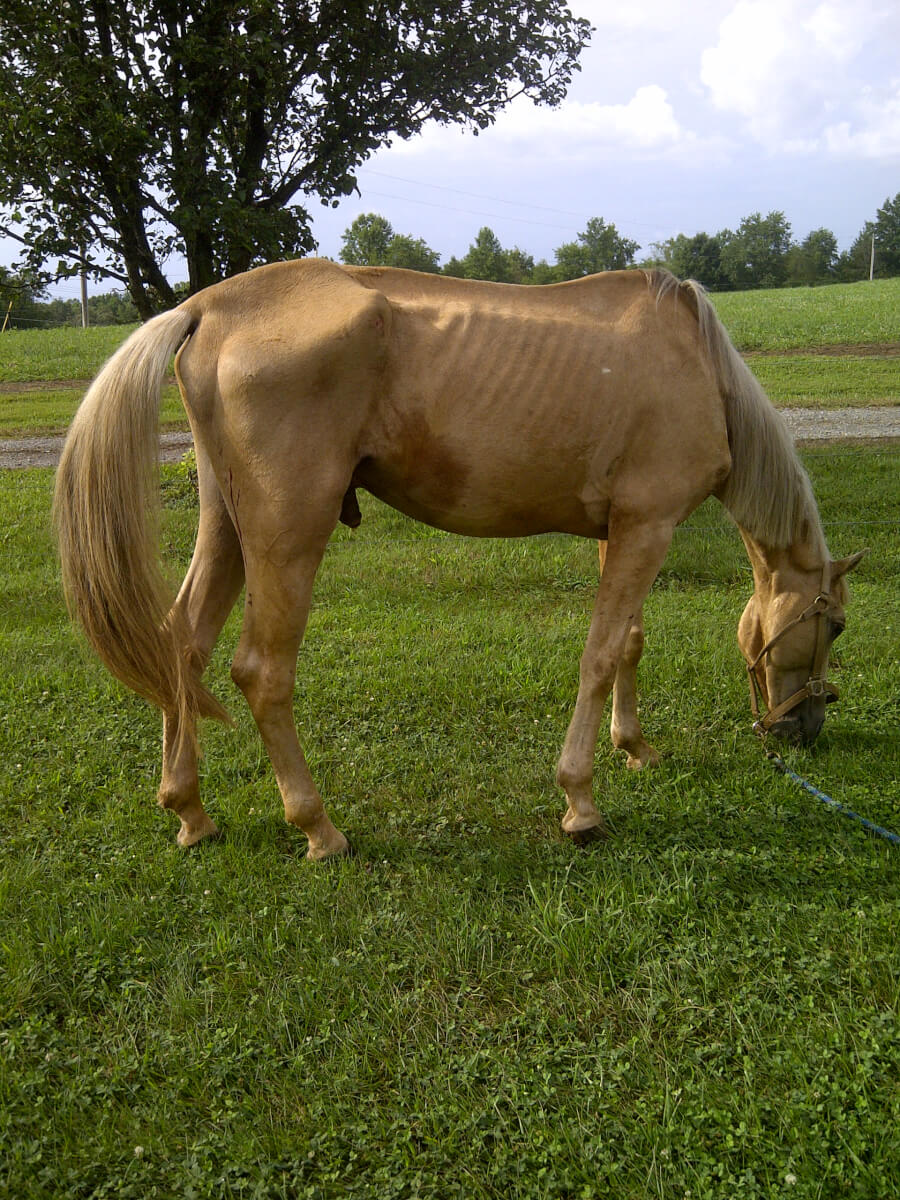
The underweight horse is a continual problem for many owners and more times than not, the approach taken does not prove beneficial. The horse continues to struggle with weight or even lose more weight. In some cases, other problems become an issue, such as anxiety, cribbing or other vices. What’s the solution? Are grains and high fat supplements the end-all-be-all for the underweight horse, or is there a better approach?
If you are dealing with an underweight horse and struggling to put pounds on them, I ask you to look closer. Take a minute or three, take a deep breath, clear your mind and focus on them. Watch them, their habits and behaviors, and even look at their feces and concurrent medical problems.
There are many causes of a horse being underweight, so it is important to rule a few things out.
- Increased intestinal parasite load or burden
- Oral dentition or teeth problems
- Concurrent illness
- Ongoing stress and increased metabolic demand
- Obvious malnutrition
Once these items are ruled out with the help of your veterinarian, many owners find themselves with a horse that still has a problem gaining weight. Let’s look closer.
The vast majority of underweight horses not impacted by a problem listed above, are usually a hotter breed, including the Thoroughbred, Arabian, and Appendix Quarter Horse. These breeds are generally leaner by nature, as this is their body type. The appendix cross will vary, dependent upon lineage. These leaner breeds are generally also a little higher strung than their draft horse, Paint, or Quarter Horse counterparts. This is just one difference between these breed types, but it is a huge difference. You do not want a Quarter Horse to look like a lean Thoroughbred, or vice-versa. This goes against their constitutional nature and it will create more problems than you desire.
Now, taking these leaner breeds into consideration, as mentioned, they are generally ‘hotter’ or more active than their heavier breed counterparts. This hotness is essentially their metabolic rate or metabolism, being tweaked higher than that of a Quarter Horse. This increased metabolic rate is like a ‘fire’ within them, increasing caloric demand, and burning through foods and moisture within their body. You, as the horse owner, try to increase food supply, but many times the choices are not correct and you can create more problems. Or in some, the choices are correct, but there are created problems that must be addressed as well, in order to obtain the results you desire.
Putting Weight on Horse; More than Groceries
In the world of Traditional Chinese Medicine, there is a concept of Yin. Yin is an aspect of health and well-being, relating to a cooling and moisturizing property which is present not just in the body, but in nature, and in food. When you have weight loss in a horse, even with a concurrent stress or illness condition, you are contending with a Yin deficiency either primary or secondary.
Think of the underweight horse as being like dry skin. Their body is often drying out and with that, moisture is lost, as is body weight. Keep in mind that fat is considered a Yin substance, either in the body or in food, but it is not an ideal Yin substance. If you have a dried out and withering body, in order to replenish it or build it up, you need moisture, which is the Yin aspect. If you continue to deplete Yin from the body, you will make health and behavioral problems worse.
In many cases of these underweight leaner breeds, you will notice that behavioral problems escalate. They become harder to handle, more anxious, more cribbing, and even more stomach ulcer problems. These are all connected to this Yin aspect and are created out of a Yin deficiency state. Here again, think of that ‘fire’ in those horses. It is burning up the moisture, increasing metabolic rates and drying out their body. In response, many owners feed high amounts of grains, or pulp products, which are all simple carbohydrates. These increase energy and thus, increase that fire within the body of the horse. These simple carbohydrates are ‘heating’ by nature because of this effect upon the body. It is not hard to see then why many horse owners fail to gain ground or contend with ongoing medical issues and anxiety, such as cribbing and ulcers, with this approach. You are fueling the fire, literally.
In order to help that leaner horse with no major medical issues to gain weight, you require three things:
- High quality forage (protein >15%) with no grains
- Controlled digestive fire or digestive capability
- Yin tonics and foods
High Quality Forage and the Underweight Horse
High quality forage goes without saying, when it comes to any horse with weight issues. This is a common cause of a horse being underweight, in fact. Many owners simply do not feed high quality forage, but instead utilize ‘grass’ hays which are very low in protein and nutritional value. In fact, many owners of metabolic horses make this mistake too and are told to steer clear of forages such as alfalfa. Big mistake! Most of these horses, metabolic ones included, are literally starving for nutrition and the lack of nutrition is fueling their conditions.
If you desire for your horse to gain weight, I highly recommend alfalfa or an alfalfa-mix forage, provided at 2% of bodyweight per day, if not higher. They will thank you more times than not, as long as other factors are controlled, such as lifestyle, grain feeding, and high usage of synthetic supplements.
Controlling Digestive Fire in the Underweight Horse
In order to digest food and extract nutrients, the digestive tract requires some ‘heat’ and likes to be warm, like boiling a pot of water. Heat is required to ferment food in the horse’s digestive tract, as it is in ours.
Now, for many of these leaner horse that are underweight, their digestive fire is on ‘high’ and considered excessive. This high internal heat burns up calories, stirs up their emotions and contributes to stomach and hindgut ulcers. It also leads to very dry fecal balls. The normal fecal ball in the horse should be green in color, due to high chlorophyll levels in high-quality forage, and when squeezed with a gloved hand, water should drip out. In these hotter horses, the feces are often brown in color and crack open due to dryness, with no moisture upon squeezing. In fact, their feces often crumble when hitting the ground after defecation.
This is a result of a high internal digestive fire or heat, but is also a result of improper food choices.
When you feed grains, you are increasing that heat. When you feed high levels of synthetic supplements, like vitamins and minerals, or ration-balancers, you are also increasing that heat. Synthetics, in any supplement, are often heating in nature. Turn up that heat and you further dry out the body and contribute to more heat and more problems, including weight loss.
The high internal heat is often produced as a result of lifestyle, high stress, medications, or improper food choices. Yin foods and herbs are cooling in nature, quenching or controlling that heat. If you do not feed adequate Yin foods, which includes high-quality forage, then you are creating more heat, which then depletes the body further.
Bottom line? You have to control that high digestive fire or your efforts may go unrewarded. The main herbal formula that we use is Cur-OST EQ Stomach, which is a blend of marshmallow and aloe gel extract. Both of these herbs are cooling and moisturizing in their properties, but both also can dramatically impact the digestive microbiome and enhance the process of digestion.
Using ulcer medications over and over is not a solution. These medications do very little for the underlying process mentioned above and in fact, some are known to reduce absorption of various minerals, including magnesium. May want to rethink continual usage of these medications in your horse.
Now, with that being said, there is a converse side to this digestive fire and that is a deficiency state, rather than an excess one. This is common in the horse with high parasite loads or the horse that has an ongoing illness or has just lost all drive to live after prolonged starvation. When the digestive fire is in a state of deficiency, there is more coldness to the body. These horses often lack energy, have loose feces, low appetites, and often immune related problems. In TCM, this is referred to as a spleen-Qi deficiency state.
The reason I mention this is that in those horses, you have to be careful about feeding that high-quality forage or Yin foods or herbs. The reason being is that these foods, while needed and being vital, can be difficult to digest. Thus, they require a moderate to high digestive fire. In those deficient horses, I will often use a gut blend called SV EQ Gut Blend III, which targets and improves this digestive fire. Once this fire is stoked, you can then increase the quality of the forage and use the Yin foods or herbs. You wouldn’t want to use this supplement in a ‘firey’ Thoroughbred for obvious reasons.
The Underweight Horse and Yin Tonics or Foods
Yin foods are those which help to add a cooling and moisturizing property back into the body, which equates potentially to increased weight gain. Yin foods and herbs are also innately high in nutritional value, including macro and micronutrients. Yin foods and herbs are also ‘grounding’ in effect. Many are root vegetables, and being from the earth, they ground the body and build mass. They often help to ‘ground’ excessive emotions, such as anxiety as well. As a note, some fats could be considered Yin foods, such as Flax Seed, but for completeness sake they are not sufficient due to overall lack in nutrition outside of fat molecules.
There are many Yin foods and herbs. These foods or herbs are often ‘root’ vegetables and contain high levels of complex carbohydrates, in comparison to grains being more simple in nature. These high levels of carbohydrates help to bind water and enhance other aspects of health. In fact, these carbohydrates often benefit the digestive microbiome, the immune response, and the process of inflammation. They also help to ‘cool’ the body down and reduce that fire aspect, which in turn helps to build up reserves and build body mass in the horse.
In truth, almost every horse could benefit from a Yin tonic to some degree. In Traditional Chinese Medicine, it is believed that the aging process itself, along with stress, depletes the body of Kidney-Yin, which then leads to high internal heat, body weight problems, and inflammatory changes. However, with that said, not every horse is ‘ready’ for the Yin tonics.
If I have the goal to supplement Yin in a horse, here is my list in order of preference:
- SV EQ Kidney & Yin Blend– a blend of several Yin tonics
- Mung Bean – a powdered and very palatable Yin tonic, very easy to digest and benefits digestion and high in nutritional value (dose = 2-4 tbsp once to twice daily)
- Sweet Potato – very high in nutrition (dose = 1-2 tbsp once to twice daily)
- Beet Root Powder – very high in nutrition and added health benefits (1-2 tbsp daily)
- Flax Seed Powder – very high in beneficial fatty acids and calories (dose = 1/2- 1 cup daily)
You can try one or in other cases, use multiple. You just have to watch your dosing, due to the heaviness of the foods and herbs in the Yin tonic category. Monitor your horse’s feces for looseness or situations where there is excessive gas production.
A quick word on Flax Seed Powder. First, make sure you are using a high-quality product. Flax Seed is very prone to rancidity and thus, can create more inflammation in the body of your horse. Smell it and look at it. It should smell rather sweet and aromatic, having a high moisture content. Many products on the market are rancid and dried out. Second, watch the ‘fat’ supplements in those metabolic horses. They simply do not need them, in comparison to a true Yin tonic.
There are other Yin foods, such as Wild Yam and Rehmmania Root, however, if I choose to use them it is in a combination blend, as found in the SV EQ Kidney and Yin mentioned above.
Keep in mind the importance of that digestive fire. Feed Yin tonics and foods to a horse with a low digestive fire and you can quickly produce problems, not to mention gas and loose stools.
Author: Tom Schell, D.V.M, CVCH, CHN