

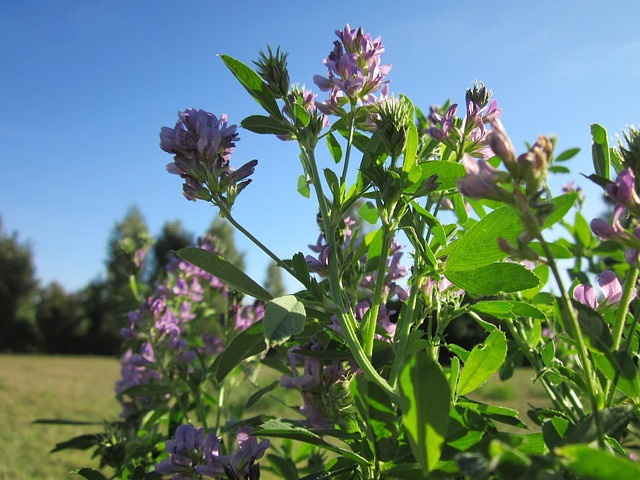
Alfalfa. One of the most important sources of whole food nutrition for the horse but often overlooked or easily dismissed for many reasons. In most cases of health and lameness problems in the horse, what is required by the body to heal and recover is food, real food and nutrition. This is not the type that comes in a pouch of synthetic vitamins and minerals with additives and flavoring, but true food. Alfalfa is one my go-to choices for forage in the horse recovering from any health or lameness problem, and it is also one that we feed daily to our personal horses despite no health issues. You cannot replace true whole foods.
Alfalfa is a very popular but sadly dismissed forage in the horse. Better known by its botanical name, Medicago sativa, alfalfa is a member of the legume family and thus, closely related to beans. Beans, as many know, are packed full of nutrition from vitamins and minerals to protein, fiber, beneficial carbohydrates and phytochemicals that possess medicinal benefit. The reasons that alfalfa is often dismissed by many horse owners range from ‘causing’ enteroliths to creating gas or even a hot-tempered nature in the horse. After using this forage for close to 30 years in personal horses and in hospitalized ones, I do not note these problems and if someone does say it is problematic, I view it as coincidence because there is always more to the story.
Now, some horse owners are concerned about GMO applications or the use of ’round-up’ ready versions of alfalfa. I cannot attest to this as being a problem and many times, at least in our area, this is something that cannot be avoided. Even with this being a real factor in the world of agriculture, again, I have not encountered any negative effects in the horse. Why? To be honest, in my research years ago regarding glyphosates and the impact on the body, one thing is evident and that is that proper antioxidant usage, ideally from whole foods, can mitigate the impact of this toxic compound. I’ve not only noted this with alfalfa, but many other ‘toxic’ compounds on our property and in the pastures. The top of this list is likely acorns and how our horses have consumed them like candy but have never encountered the serious side effects that other horses encounter. I think it is wise to be aware of these toxins in the environment and likely in our foods, but if we choose properly and understand the physiological process in the body, they have not posed any problems for me as a veterinarian and our personal horses.
Alfalfa: Why Use it in the Horse?
As noted, prior, alfalfa or Medicago sativa, is from the legume family, which is well known for its whole food nutritional benefits and phytochemicals that can impact health in many species. This level of nutrition is not even closely accomplished by any of the typical grass forages that most horses are fed, including orchard grass and timothy. There are other legume forages that provide similar nutritional benefits, with Lesbedeza being one of them. The choices can vary dependent upon the region of the country or the world and what is cultivated in those regions. Outside of these other forages, while the grass hays are most popular due to ease of acquiring them and pricing, there is no comparison on a nutritional level. Alfalfa will almost always offer a much higher protein level, usually in the range of 20%, while the grass forages will average between 9-12%. This is of course dependent upon harvest and storage but is pretty consistent. The nutrient provision is also vastly different, but many are concerned about the Calcium: Phosphorus ratio and creating harm in the horse. The ratio is higher than typical but again, I have not encountered any problems. If you have concerns or bad experiences with alfalfa, I will say that there is more to the story and more going on with the horse, their regimen, or their lifestyle that is not being revealed or looked at.
The body of the horse requires nutrition, both macro and micronutrients, to function, heal, ward off disease and remain healthy. I recall years ago in practice that many of my horse owners fed alfalfa or an alfalfa mix. Those that did were not commonly calling my practice with health concerns. The ones that fed a lower quality forage, especially fescue or Bermuda varieties, were common on my call list. I’m not implying that these forages created the health problems, but they certainly contributed due to lower nutritional levels and the fact that Bermuda is commonly associated with gas production and even some colic cases, which is due to the fine blade nature of the forage. It’s interesting how this was taught to us in veterinary college some 35 years ago but overlooked today.
Overall, the horse requires nutrition. If we look at any health problem or even lameness condition in the horse, and look deeply at it, we see a few things. First, most of the health ailments and lameness problems are directly associated with chronic inflammation in the body. Second, in order to heal the body on a cellular level, including joints and other tissues, the body requires proper nutrition. I recall about 15 years ago; we did a small trial with metabolic horses and elevated insulin in our clinic. The horses were kept at our facility so we could control their regimen, and they were placed on alfalfa, along with a protein based whole food supplement. Nothing more, nothing less. Within 30 days, the insulin levels returned close to normal, and the horses had improved in all factors from energy to body condition and lameness scores if laminitis was present.
In almost every one of the consultations that I conduct with horse owners, my number one recommendation is to improve the forage being offered to pure alfalfa or an alfalfa mix. This is purely from an experience perspective and also one of logic, based upon cellular research. Do I get negative responses from the owners? Yes, for sure, but the choice is entirely up to them. Many claim they are giving a vitamin-mineral ration balancer, which covers nutrition, but this is not true. They are entirely different. One creates health, being whole foods, while the other can inflict more harm, including digestive problems and microbiome disturbances. Again, research supported and noted after close to 2,000 fecal cultures being performed in our lab along with histories on every horse.
Alfalfa; True Whole Food Benefits for the Horse
Many horse owners will tell you that their horse only needs the grass forage and the vitamin-mineral supplement. When I raise the point that there is a major difference between whole foods and synthetic nutrients, many either do not understand or possibly deny it. My goal, as a veterinarian, is to help the horse and enable that horse to heal its body. It is entirely possible and a sight to see when the right approach is provided.
A whole food provides the macro and micronutrients that we commonly chase in synthetic based products. Actually, that is not true. Most synthetic vitamin-mineral supplements do not offer the protein, fat, fiber or beneficial carbohydrates, that are the macronutrients in whole foods. In addition to this nutritional provision, whole foods contain within them natural antioxidants and other phytochemicals that impact health, not just in the horse but all species that consume them.
Most true whole foods have been used in various cultures as ‘medicine’ to help the body to heal and recover. Hippocrates once stated, “Let your medicine be your food and your food be your medicine.” There is a reason for this statement and a very good observation from one of the forefathers of medicine. In various cultures, alfalfa was used to improve memory, aid kidney problems, treat coughs, aid muscle recovery, a general rejuvenator of the body and energy, antidiabetic properties, anti-inflammatory benefits, anti-fungal properties, anti-allergy benefits, and even a positive impact on the central nervous system and neurological problems. In the middle east, alfalfa is used in cases of arthritis and also to benefit the cardiovascular system and heart health.
Alfalfa has been noted to contain many phytochemicals that can benefit health on many levels. These include alkaloids, enzymes, amino acids, coumarins, digestive enzymes, saponins, flavonoids, vitamins, minerals, phytosterols, and even a thyrotropin releasing hormone agonist. The list of these phytochemicals is extensive, and I would refer the reader to the article cited below for a complete list based on research.
The health benefits of alfalfa, based upon research, include:
- Benefits to the cardiovascular system, plaque formation, circulation, and cholesterol
- Improve insulin function and lower blood sugar (possibly manganese related)
- Natural phytoestrogens that can impact hormone regulation and balance
- Immune enhancing properties due to polysaccharides
- Distinct anti-microbial and anti-fungal benefits due to saponins
- Supports normal digestive function and microbiome balance
- Significant antioxidant and anti-inflammatory properties
- Beneficial in arthritis, convalescence, debility, and aids with weight gain
- Benefits those with digestive ailments, protein allergies, stomach ulcers, and estrogen imbalances
- Improves appetite and intellect and memory
- Anti-cancer properties
- Benefits blood loss conditions or those with anemia
There is one potential ‘toxicity’ associated with feeding alfalfa in all species but is mainly related to feeding the seed versus the leafy forage. This concern is due to higher levels of a non-protein amino acid called Canavanine, which can create health problems in some due to interfering with binding of the amino acid Arginine in many cellular processes. Interesting, though, Canavanine has been shown to have anti-tumor properties in many animal species. Either way, the level of Canavanine is generally much lower in the leaf forage versus the seed. It has not posed a problem in my years of usage. Canavanine has generally been associated with relapses of systemic lupus erythematosus in humans. (Bora, Sharma, 2011)
Overall, we have a major difference between that synthetic based vitamin-mineral supplement and a true whole food, such as alfalfa. This difference holds true for most whole foods but overlooked. If we looked past the many phytochemicals present in alfalfa and purely looked at the fiber level that it provides and how this by itself can impact digestion, microbiome balance, and overall health, this would be reason enough in my book to benefit any horse. In reality, comparing alfalfa or any legume forage to a typical grass forage is like comparing Iceberg lettuce to Green Spinach. Both provide some health benefits, but the later is much greater.
Author: Tom Schell, D.V.M, CVCH, CHN
Further Reading:
Alfalfa, Equine Allergies, and Digestion – SecondVet
Whole Real Foods; Your Horse’s Health and Well Being – SecondVet
Vitamin Supplements and Ration Balancers in the Horse – SecondVet
What about sainfoin?
What if you have an overweight draft cross? The alfalfa won’t help with weight loss.
Thank you. The horse is overweight for a reason and there are usually many reasons. To blame an overweight body condition on pure nutrition is problematic, when ironically what that horse needs is real nutrition. Can a horse gain weight on Alfalfa? Sure, but there are reasons for this including lifestyle and exercise, not to mention the other factors surrounding that situation. In my hands, an EMS horse loses weight on Alfalfa, simply because their entire regimen and lifestyle are altered. I hope this helps. Tom Schell, D.V.M.
What about it mostly being gmo and sprayed heavily with round up? Does this not concern you?
Hello. Does this concern me? Simply put, not it does not when you look at the grand scheme of things in food generally speaking. You mentioned GMO, but do you know what GMO modifications they have made to alfalfa? Generally, so that it is more resistant to glyphosate so the farmers can spray the fields to keep weeds under control. Glyphosate is applied to these fields based on EPA standards, so deemed safe? Well, most other foods are also sprayed either with glyphosate or 2,4 D to keep weeds under control. These herbicides are everywhere, including the food you and I eat as well as likely the water we drink. Is it harmful? Sure, but many things are harmful in life and our food, but if we look at the science, the research tells us that antioxidants minimize the impact of these ‘toxins’, which they do. So, to reject a food like alfalfa for this reason, when it is packed with nutrients and antioxidants, but instead opt for a low-nutritional value grass forage or even something like Orchard or Timothy, which is also low in nutritional value compared to the legume, does not compute in my mind, especially when we take into consideration that those grass forages have likely been sprayed with 2,4-D. I think it is important to understand what is really going on, especially when it comes to nutrition. I hope this helps. Thank you. Tom Schell, D.V.M