

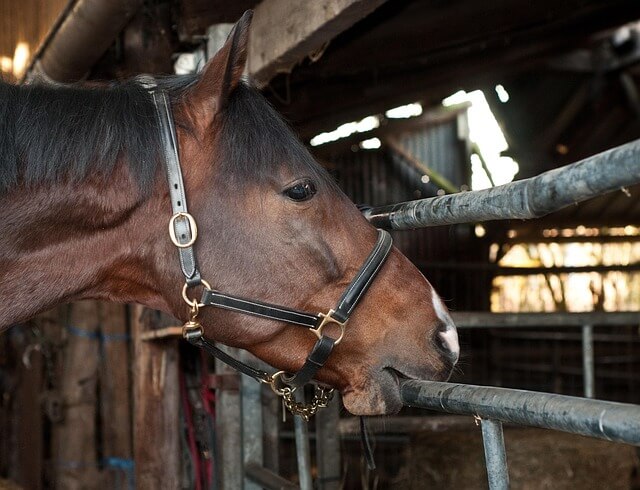
Tension and stress. It is all around us in society and likely in our bodies, but it is just as apparent in the equine community. Tension is a response by the body of the horse to a stressor, and this physiological response can impact their health and overall wellbeing. The liver is involved, at least from an alternative medicine point of view, resulting in energy or Qi stagnation within the body of the horse. If this energy is not moving well or flowing smoothly, especially in the long-term, then your horse’s health and soundness may be compromised.
In a prior article, I discussed the liver of the horse, function from an alternative medicine perspective and how seasons such as springtime impact its function and the health of the horse. The liver is a very important organ in the horse, both from a western medicine point of view, as well as eastern, implying alternative medicine. The health of the liver, from a larger perspective, impacts the function of other organ systems in the body of the horse, impacting digestive health, immune function, healing ability, and overall health.
Briefly, the liver is one of 5 major organ systems in Traditional Chinese Medicine (TCM) and follows the kidney and comes before the heart in the promoting cycle of organ connection. Every organ is interconnected in TCM and when one organ is over stressed or compromised, then other organ systems are as well. Everything is connected, not just in the whole scheme of life, but in the body of your horse. We tend to view health and soundness problems as simplistic, meaning the problem is just that one condition, when in fact, the main concern is usually connected intimately with something else in the horse. Thus, in alternative medicine, we try to view the whole body of the horse and not get too focused on the main complaint by the owner, whether if that is a lameness or a specific health problem.
The liver is viewed in TCM as being the storer and mover of both energy (Qi) and blood in the body, aside from other functions including detoxification and influence upon digestion. The liver is also viewed as having a direct impact upon other body systems or organs outside of the main organs. These secondary organs that are influenced by the liver include soft tissue structures including muscle, tendons, and ligaments, as well as the hooves and skin health. The eyes are also a main organ influenced and reflective of liver health and function.
When I mention an impaired liver in the horse, I mean an organ system that is stressed, undernourished or overworked. This does not mean that you will see elevated liver enzymes on a chemistry panel in your horse, but if the condition persists over a period of time, then it is possible to see bloodwork changes. This would be evident in the pony or horse with hepatic lipidosis and fatty liver syndrome, the horse with gall stones concerns, and even some metabolic syndrome horses.
Generally speaking, we suspect liver involvement and need for support in TCM when we see conditions in the horse which include:
- Tendon and ligament concerns
- Hoof health concerns
- Skin health concerns
- Allergies
- Digestive concerns
- Eye concerns
- Metabolic concerns
- Behavioral issues/anxiety/anger/and vices such as cribbing, pawing, or weaving
Liver Blood and Yin Deficiency and Qi Stagnation in the Horse
The topic of Qi or energy stagnation in the horse is one that is not discussed too often, although it is present in the vast majority of the equine population on one level or another. It is a very important topic, but rarely addressed, thus most problems in the horse persist for months if not years, or more times than not become worse.
I have written another article regarding the concept of colic, pain, and stagnation in the horse, and would encourage the reader to reference this for a more complete picture of this important topic.
The main focus of this article in particular is to again address this concept of Qi stagnation in the horse’s body. The liver as mentioned, in TCM, is viewed as being responsible for the smooth flow of both energy (Qi) and blood in the body of the horse. For optimal health in the horse, both energy and blood must flow to all areas of the body. When this is not happening, then disease occurs on many levels. There are a few things to note, however, which are reiterated from my prior article.
View energy and blood flow in the body of the horse as being a river or stream of water. The water could be the energy and blood. When the stream is flowing well and within its boundaries, then all is well in the overall environment of that stream and the life within it. In order for that water to flow downstream, there must be water coming from upstream. If there is not enough water coming downstream to keep things moving, then the water will tend to pond up and become stagnant, then things are not so healthy in that environment. If there is too much water coming downstream, then the water can overflow its banks and pond up just the same, becoming stagnant in some areas. Again, not so healthy for the environment around that stream or the life within it.
Energy is needed to move blood in the body of the horse. This should be pretty obvious, right? A pump can move water out of a pool, but energy is needed to make that pump work. So, the heart is needed to pump blood, but the liver is also needed to move blood to the heart and filter it. Energy is needed for both of those organ systems to function. If energy is deficient in the body of the horse, then energy can build up in some areas of the body, like the stream. If energy is not moving, then over time, blood movement can become impacted. This would be viewed as Qi or energy stagnation secondary to a Qi or energy deficiency. On the opposite side of the coin, sometimes we can have too much energy being produced in the horse, especially the younger ones or the ones under stress, which cannot move freely and becomes stagnant in the body. This can also then impact blood flow in the horse, resulting in a blood stagnation situation. This would be viewed as Qi or energy stagnation secondary to an excess in the body.
Symptoms of Qi stagnation in the horse include:
- Behavioral problems including stubbornness and anxiety and overall body tension
- Colic and gas accumulation
- Muscle tension, especially the neck or cervical region but also lower back
- Muscle cramping or rhabdomyolysis
- Tendon and ligament injuries, especially with poor healing or recovery
- Generalized pain but hard to locate and often comes and goes
When this Qi or energy stagnation continues and is unresolved, it can progress to blood stagnation with symptoms including:
- All of the above symptoms but on a more severe scale or level
- Pain that is sharp and easy to locate the source or area impacted
- Bounding pulses in laminitis or any foot injury or trauma
- Darker pink or purple color to the tongue and mucous membranes
The precise cause of energy or Qi stagnation in the horse, which may lead to blood stagnation, are numerous but in general include:
- Poor nutritional program to support the liver with nutrients
- Poor digestive health
- Stress (mental and physical)
- Poor lifestyle and proper stress release
To take things slightly further, but not meaning to complicate the topic, if this energy or Qi stagnates in the body to a high degree or a prolonged period of time, heat will develop in the body of the horse. This is logical because if any energy stagnates, friction will arise, and with that, heat is produced. This heat in the body of the horse can and does then complicate health matters. It can rise upward and stir the mind, creating behavioral problems on a higher level. It can contribute to ulcers in the stomach and large colon, or even impact inflammatory problems on a skin level, EIPH or respiratory bleeding, and heat induced laminitis. This heat in the body of the horse is often made worse during the warmer times of the year, such as summertime and the rise of laminitis or other health issues. In the long-term, the heat can literally dry the body of the horse out, which is often evident in the feces first with hard and dry fecal balls. This is a depletion of body reserves, signified by blood, nutrients, and the concept of Yin in TCM. Here is a nice article about heat in the horse.
The overall topic of Qi stagnation and the liver in the horse is an important one and something that I encounter on one level or another in every equine patient during consultations. Every health condition that I have encountered in the horse is on some way connected back to this concept of liver health and function, which then impacts energy and blood movement. We need both energy and blood to heal any condition in the horse and if these are negatively impacted, then to make progress, we must improve the situation. There are often many factors involved, as noted above, and in reality, we need to alter every one of them to make progress clinically in the horse.
Herbal formulas that I use to manage both the cause and problem of stagnation in the horse include:
There are individual herbs which can be added to the above-mentioned formulas that can dramatically impact overall stagnation and discomfort in the body of the horse on many levels. One herb that we use often is White Peony, which is well known in the world of TCM to aid in helping to soothe the liver, move the energy, and even provide some calming effects to the body. This herb is used on some of our custom Secondvet formulas and can make a huge difference. The average starting dose when adding White Peony to the above formulas is around 1/2 tsp once to twice daily per 1000 lbs in the horse.
Author: Tom Schell, D.V.M, CVCH, CHN
Recommended Reading:
The Horse, Their Liver, and Springtime – Nouvelle Research Official Website
Detox and Your Horse. The Most Important Herbs and Why. – Nouvelle Research Official Website