

It is hard for many owners to see their horse as stressed and even more true for pet owners. This is a hard concept to grasp for some reason but likely stems to our perception of what stress is, attempting to relate our lives to theirs. Our concept of stress in the horse is incorrect, at least from a scientific point of view, and this lack of true understanding impairs our ability to help them. The stress they are contending with in their lives is contributing to their ongoing health and lameness struggles. The question is whether or not you recognize it?
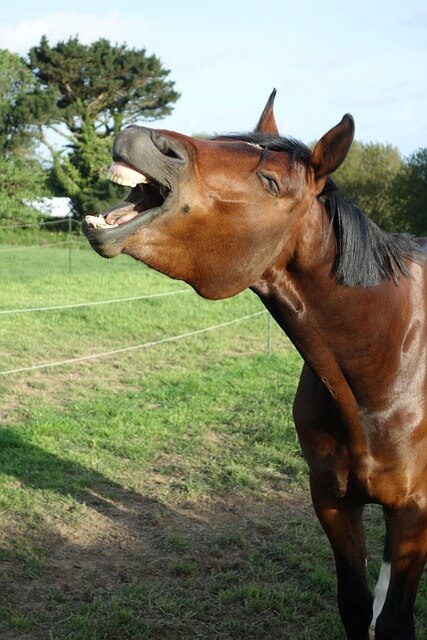
The photo that I am using for this article could be a horse that is yawning or could be a horse that is vocalizing. I do not know either, but for purposes here, I will state that he is yawning. Now, while the act of yawning is commonplace in the horse world, as it is in humans, it is actually a sign of not just fatigue, but also boredom, depression, and even stagnant energy in the body of that horse. It is interesting, as over 30 years ago, one of our clinicians in veterinary college actually noted this and recommended to the students to have liver function tests performed on those horses that were yawning often. I say that is interesting because in the world of TCM, the liver is directly involved. The act of yawning should tell us something, just like it does in our own bodies.
What I would like to have here, image wise, is a photo of a depressed horse with their head down and ears either flopped to the side or facing the rear. This is actually a common trait that I see in many of the metabolic and Cushing’s patients during consultations when the owners send me photos. The horse is depressed, emotionally, for many reasons and this state of depression is then contributing to their health, not much different than it does in humans. We just fail to make connections, or maybe we just don’t want to see it?
What is the Stress Response in the Horse?
Several decades ago, during the 1950’s, a researcher by the name of Hans Selye invested much time into the study of the stress response in the body of rodents, then transferring it to humans and their health. Hans Selye is considered many as a pioneer into the study and understanding of the stress response and the movement into further study and research. Now, there was much that we did not understand during those times, regarding physiology and even blood testing, but despite this lack of complete understanding, his conclusions stood true. Sometimes deductive reasoning and common sense play a more important role than detailed scientific analysis and complicated testing.
Stress is a physiological response by the body and an alteration of body chemistry, in response to a stressor. You can say that you are ‘stressed’ but that is the response of your body that you are feeling. The question is, ‘what is the stressor?’. What Hans Selye noted was that there are many stressors that can inflict a stress response upon the body, from a change in environmental temperature, to a change in a job, lifechanging event, or even a medication. However, no matter what that stressor was, the body’s response physiologically is the same. It does not matter what that stressor is or was, because the response is the same. The stressor or stressors, however, are important because in order to create change and alter the damaging effects of that stress response in the body, you have to identify and alter those stressors.
Now, before I move forward, it is important to note, as Hans Selye pointed out, is that the stress response is almost always present. We cannot live a stress-free life, nor can the horse. In fact, the stress response is needed for health on certain levels, and allows the body to grow, strengthen, and overcome challenges. Hans points out that a life without stress equals death. True on many levels. Just think of the natural stressors that a foal is responding to as he ages and turns into a yearling. Or, how about the stressors required by the horse that is training for the next Rolex event or Kentucky Derby? If they wish to become a top-level athlete, they must overcome those stressors, however, there are limitations and if the ability of the body to adapt and overcome is impaired in some way, then we can have negative outcomes. This could be a training injury or even higher rates of infectious disease, including EPM, influenza, or herpes in a barn. It could also relate to higher incidences of metabolic syndrome and Cushing’s syndrome in the horse or other health problems including ulcers, colitis, anhidrosis, and even allergies as examples.
Hans Selye studied the stress response in the body, which heavily involves the hypothalamic-pituitary-adrenal axis (HPA axis), which is interesting to me because this is the same physiological pathway that many horses with perceived Cushing’s disease or PPID are contending with over time. Is there a connection???
Hans broke the stress response down into a sequence of three events or phases.
The first phase is the acute phase, where the body is exposed to a stressor which can vary in intensity. If the stressor is distinct and impacts the body or mind, the body will respond by an increase in ACTH secretion, an elevation of glucose, elevation of cortisol levels, and often a rise in insulin. This is the response of the HPA axis. Does this seem like a Cushing’s horse or a horse with metabolic problems? Here is an article on PPID and the HPA axis.
The second phase is the adaptive phase, where the body of the horse or person, attempts to adapt to and overcome or adjust to the stressor. This is considering that the stressor is persistent and not letting up in intensity or resolving. The body will respond with an effort to create homeostasis or regain balance and harmony, resisting the stressor to certain degrees. However, the stressor continues.
The third phase is the exhaustion phase where the body can no longer fight or resist the stressor. The body of the horse is literally exhausted and cannot fight anymore. The elevated levels of ACTH and cortisol are creating health problems and tissue degradation, and the lack of proper insulin response means that cells are not being ‘fed’ properly to create the energy required to continue onward. As Hans Selye pointed out, the exhaustive phase will lead to death in most instances. It is interesting to note this connection between exhaustion and the Yin depletion in the horse and all other beings.
There are three distinct clinical features that Hans noted in most stress responses as well. These included:
- Increased size to the thymus gland
- Lowered levels of lymphocytes (immune response cells)
- Gastric ulcers
Now, knowing this information, can you begin to maybe make connections with the horse in your life?
Why is the Stress Response Important in the Horse?
The stress response is important in the horse because it is playing a very important role in the creation of most, if not all, health and lameness problems we contend with in veterinary medicine. We tend to just think of ‘stress’ as being something we experience when we have too much going on in our lives or we are too busy, however, this is incorrect. The stress response is also present if you decide to go for a jog one morning, are exposed to very hot or cold temperatures, take certain medications that alter physiology, have an altercation with another person, or honestly, even if you just wear the wrong shoes one day that hurt your back. It is just a question of how prolonged that stress response is to that stressor, in combination with other concurrent stressors. If you couple those individual stressors with the fact that you also have anxiety, depression, diabetes, cardiovascular problems, or other health issues, the stress response becomes more important simply because your body has already been under chronic stress. Now, you are adding to it and thinking you can overcome all of those stressors, which is the second phase. How long can you keep it up???
The same situation goes for the average horse. As I mentioned prior, most consultations with horse owner contending with metabolic ailments or Cushing’s disease show me a photo of a horse where their head is down and often, ears are back. They are depressed, low in energy, and generally have a disinterest in much of anything and really do not engage with the owner. This is the stress response you are seeing, in the second phase. The problem is literally staring you in the face, but instead, we are ingrained to look at the effects, such as a high insulin or ACTH level, a lame horse, or even a tendon that will not mend. Those are effects, but yet, they are also contributing to the problem and making it a viscous cycle of events in the horse.
What do I see commonly?
In many horses, I see lifestyles that are restrictive with little interaction with other horses. Most are on dry lots or small paddocks for short periods, then stalled. Many horses simply have zero turnout available. They are overfed forages that are low in nutritional value, then given loads of vitamin mineral supplements and other means of providing ‘nutrition’. They are sore and stiff, often with various degrees of laminitis or foot pain, which is created by improper trimming and balance to the foot. They have sore necks, sore backs, hind limb problems, and many times there is irritability. All stemming from sore front feet which are then feeding into the entire body, being created by improper stress upon the foot, and then feeding into a larger cascade of stress in the entire body of the horse.
I also see horses with no topline and a general loss of body conditioning, simply wasting away on various levels. This is interesting to note because while diet does play a vital role in rebuilding the body of the horse, the stress response will cause massive destruction. As noted above, there is an increase in the cortisol levels, which is a catabolic hormone and will cause tissue loss and degradation over time. Thus, with chronic stress, we see a drop in the immune response, weight loss, and general catabolism to the body. This impacts every aspect of the horse from muscle to tendons, ligaments, hooves, immune function, organ function, and even mentation.
Taking this concept of cortisol elevation further, it is not hard to see how the horse that is given oral corticosteroids for asthma or irritable bowel disease becomes worse clinically, or that horse that receives a joint injection with corticosteroids develops infection or laminitis. This is partly why I warn owners with metabolic horses to really consider what they are doing before they put their horse on a corticosteroid or have their veterinarian inject a joint for a lameness. The outcome could be disastrous. I have an article on this topic below.
A photo tells a thousand words. Just looking at how the horse is standing, how they are holding their head, placing their feet, and the position of their ears gives me more information than $1000 worth of blood tests.
The stress response is present in every horse, but it is a question of whether or not there is harm coming from it. Today’s world in the equine field is entirely different than 20 years ago. I personally think we are creating the majority of the health and lameness problems in the horse by our choices, including forage, lifestyle, farrier work, and the medications used. My goal during consultations is to point out this stress response, then the individual stressors that I see which are present. Many owners ask me what my ‘cure’ rate is for conditions such as equine metabolic syndrome or even PPID or Cushing’s in the horse. In truth, I am not targeting the disease as it is perceived by most, which is why I am not concerned about insulin or ACTH testing. I am targeting that stress response, which is contributing heavily to the creation of your horse’s current concerns. However, many owners do not see or understand the importance of the various stressors and either dismiss them or simply tell me there is nothing they can do about them. That is okay, but you must keep in mind that every one of those stressors is playing a role. The more you change and correct, the better the outcome.
I have a few articles cited below for more education, however, it is important to keep in mind that while nutrition and even various adaptogenic herbs can readily assist the body of the horse on many levels, they are not panaceas. If you truly desire to remedy the problem and enhance health, both adaptogens and true nutrition should be used, but the STRESSOR or STRESSORS need to be stopped or altered.
I will say that considering this stress response and how it changes the body physiologically, one has to question whether if the vast majority of the horses diagnosed with PPID or Cushing’s syndrome, let alone insulin resistance, are not actually just stressed horses. It might explain the true lack of overall response to the medications that are so heavily prescribed. It might also explain why despite our very expensive regenerative therapies being used for tendons, ligaments, and joints in the horse offer short term results if any.
Food for thought.
Author: Tom Schell, D.V.M., CVCH, CHN
Further Reading:
Calming the Anxious Horse; How and Why It Is Important
Adaptogens; Rebuilding and Calming the Horse – Nouvelle Research Official Website
Adaptogens and the Horse; How and Why? – Nouvelle Research
Injecting Joints in the EMS and Overweight Horse – SecondVet