

Gut health. What does it mean in the horse? Every horse has a health problem on some level, just like every person does. The ultimate question is how far has it progressed or advanced, and how serious is the ailment. When you really peel back science and hone in on the origins of many health problems, horse or human, digestion is the key. Gut health in the horse is the key and the underlying factor in most if not all cases of health and lameness problems. The effects of the gut reach every body surface and every cell, thus, why it is so important but so often overlooked or addressed incorrectly.
If you look over this website and the educational material contained within, there is one key factor that is addressed and discussed in the horse. That key factor is gut health and the process of digestion.
For many, many years, research has slowly been making connections between most health ailments and the gut microbiome, which is the population of bacteria present in the digestive tract. While most of the science revolves around humans, they are using animals as the models and there are many articles specifically on horses. Many years ago, there was a direct connection between laminitis in the horse and an overgrowth of Streptococcus bacteria in the gut, specifically Streptococcus bovis. When we have an overgrowth of one type of bacteria it implies that there is a dysbiosis or an imbalanced digestive microbiome. Additionally, when one group of bacteria is overgrown or more highly represented, then this logically means that another group(s) is reduced in population. Essentially, with a dysbiosis, we have an overabundance of ‘bad’ bacteria and fewer ‘good’ ones. This imbalance leads to health problems down the road, or even in the short term.
Clinical Examples of Gut Microbiome Imbalance in the Horse
Let’s take a couple of examples that maybe some owners could relate to in the horse.
A grain overload situation is very common or at least was in my clinical practice. Grains are highly fermentable and will often negatively shift the digestive microbiome along with more acidic changes in the pH or acidity. A horse can consume 4 pounds or more of grain in one setting and quickly alter their digestive microbiome leading to endotoxemia and laminitis within 24 hours. Many of these cases result in euthanasia as a result of the severe impact of acute inflammation.
Another scenario is salmonellosis or severe diarrhea in the horse caused by a Salmonella species of bacteria. While we have been taught to believe this is an infection contracted from a food source or the environment, it is actually a shift in the digestive microbiome. All horses have some level of Salmonella in their digestive tract, but usually the levels are so low that they do not show up on repeat cultures. However, if through improper feeding practices or the heavy use of antibiotics, the digestive microbiome is shifted negatively, then the environment changes in the gut and the Salmonella is then allowed to increase in number. Increase it enough without intervention and you will end up in the same situation as the grain overload horse above.
Gut Imbalance in the Horse; Readily Apparent if You Look
If you ask the average horse owner if their horse has a healthy gut, most will reply with the simple answer of ‘yes’. That response comes from a person that is not looking, no offense implied, or they may not know what to look for. Many owners use over-the-counter probiotic supplements and believe all is well in the horse’s world. This couldn’t be further from the truth.
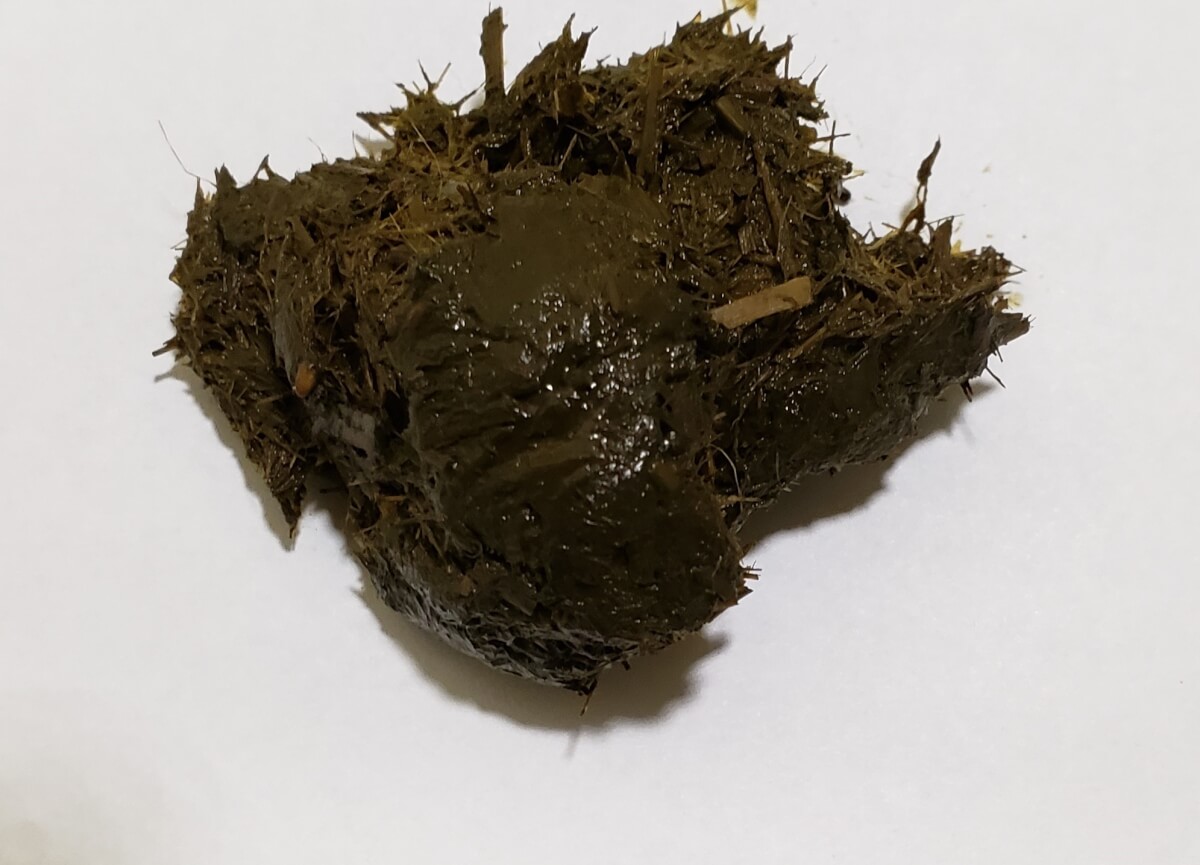
Look closely at the photo included with this article. This is just one example of a horse with a severely imbalanced digestive microbiome. The feces is a brown-green color, dark in nature, and obviously very moist with some ‘slime’ or mucous shining on the surface. This sample of horse manure also smells very sweet and rancid at the same time. Not an example of a healthy digestive microbiome. So, one has to ask ‘what is your horse’s poop telling you?‘ That article has some nice examples of what to look for in normal and no so normal horse poop.
As I mentioned in the beginning of this article, every horse has some sort of health or soundness issue. Every horse. Again, the question is how far has the condition advanced and what is the level of severity? No one horse is perfect and I do not expect them to be, but if there is a problem, then I highly recommend looking at the gut.
Many horses have obvious signs of poor gut health with gas, colic history, loose stools, fecal odor, bloating, ulcers, or otherwise. When we see these signs, the writing is on the wall. However, many others do not have digestive signs, at least that the owner will recognize or admit. Despite this, the gut is still involved.
Do you have a horse with:
- Mood swings
- Poor energy
- Weak hooves with poor growth
- Tendon and ligament complaints
- Poor hair coat or overall conditioning
- Metabolic syndrome
- Insulin resistance
- Cushing’s disease (PPID)
- Uveititis or moonblindness
- Allergies (skin or respiratory)
- Persistent lameness
- Recurrent infectious disease (EPM or Lyme)
If you answered ‘yes’ to anyone of those above, then I can guarantee you that your horse’s gut is out of balance and that the ‘answer’ or ‘solution’ IS NOT probiotics. If they were the answer, then I would have expected the incidence of these ailments in the horse to DECREASE over the years and not INCREASE like they have. Especially given the level of probiotic usage in the horse industry. Here is an article to read over. “Probiotics are the not the answer”.
The gut and microbiome are complex and when this organ system is out of balance, the rest of the body in the horse suffers the consequences. The bottom line effect of an imbalanced digestive microbiome is inflammation and it is this effect which then impacts everything from immune function to circulation, joint health, metabolism, and even insulin function. Correct the imbalance and I can almost guarantee you again that things will improve.
What creates the imbalance in the horse? Here is another great article. “Poor Gut Health in the Horse; the Top 5 Contributors.”
With every consultation and every email I receive, I highly recommend true gut support and this doesn’t just come from an herbal formula. While they help tremendously, there is always more to the story. One must change the diet and even alter the lifestyle or environment for the horse. Why? Because there is some factor that is present which is creating that imbalance in the first place and in order to truly improve the situation, this must be corrected. One cannot supplement their way out of an unhealthy diet or lifestyle.
Focus on digestive health in your horse, first and foremost, and the results will follow. Just don’t forget that the longer the situation has been present and the more damage that has been created, the longer it will take to correct if it has not gone too far.
Author: Tom Schell, D.V.M, CVCH, CHN